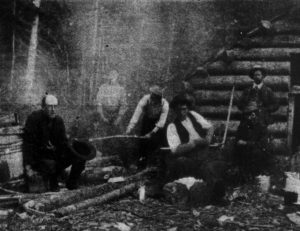
A mysterious Englishman sailed to New Brunswick in the 1850s.
His name and his fate are unknown.
All that remains of him is his diary, which recounts an incredible adventure.
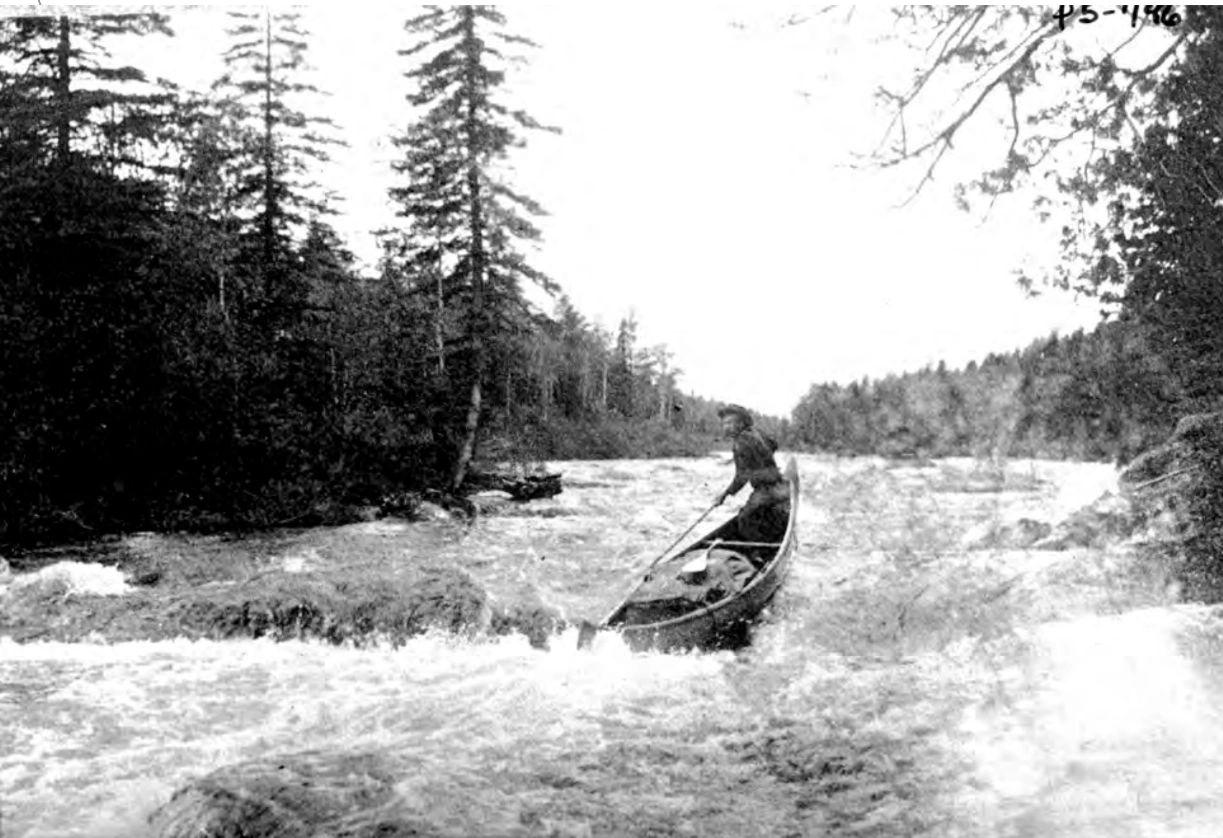
“On board the ship, July 24th, 1851. … The land is vanishing, and we are finally at sea,” began the lost diary as its unknown author departed England.
“I am the only passenger, and the loneliness of a solitary passenger at the beginning of a voyage is perhaps as complete as if he were at the North Pole.”
Sixteen years later, the diary would be mysteriously left on the steps of a printing press in London, England. It was published as a book called Journal of Two Months on the Tobique.
The publisher claimed that the unknown author was a working-class, manual labourer with no education. If true, this makes his incredibly vivid and raw writing talent all the more remarkable.
He had been inspired to go to New Brunswick by a magazine blown into him by a gust of wind in the Australian desert. That copy of Chambers Journal contained a harrowing article about a Fredericton railway surveyor named John Grant who survived getting lost in the forest for five days and five nights.
“I was strongly impressed by it!” brightly chimed the unknown writer. “I dreamt when reading it in the Australian bush … of my own wanderings into the scene of adventure!”
(The writer mentions having spent seven years in Australia. If he went there to join the then-ongoing gold rush and found some success, it could explain why money never seemed to be an issue for him.)
His ship arrived in Saint John, where he was disappointed to find a modern, industrial, big city. 1851 was the peak of the wooden shipbuilding era. In only 30 years, New Brunswick’s population had exploded from only 25,000 to 200,000 people.
The writer took a steamship to Fredericton. There he met with John Grant, who ferociously advised him to stay away from the forests around the Tobique River lest a disaster befall him, too. This only made the writer want to see the Tobique even more.
He hitched a ride North on a wagon with a soldier.
Only then did he see a Canadian forest up close for the first time. He was frightened:
“The almost impenetrable forests seem to me but little better than a large prison … surrounded on all sides by high and gloomy walls — wooden walls indeed — a “howling wilderness.””
When he told the soldier his plan to visit the forests of the Tobique, he was flat-out told he was crazy. The writer was not dissuaded from his forest dream. The soldier finally convinced the writer to at least hire a guide.
They made a considerable detour to the Wolastoqiyik village of Mehtawtik (Medictec) where he introduced him to Joe.
Joe agreed to guide him, for a hefty fee. The writer paid Joe $6, plus another $1 for supplies — enough money for Joe to feed his family of six for the whole winter.
The two of them set off by canoe up the Saint John/Wolastoq River. Back then, New Brunswickers used the river’s English and Welastekwey names interchangeably, sometimes switching from one to the other in the same sentence.
The writer assumed New Brunswickers would be racist towards Joe, but one night, when forced to take shelter at a farm during a storm, he observed “They treated Joe with as much consideration as if he were a white man, and with all imaginable politeness.”
On a darker note though, Joe was terrified of lumberjacks, hiding when he heard them. Joe explained that a Wolastoqiyik man had recently been robbed and murdered by lumberjacks.
“The lonely river is well suited to deeds of violence,” observed the writer. “No doubt the greatest ruffians of the country are occasionally found in the lumberers camps. … I’ll keep our fire-arms in a state for service.”
As they moved upriver, the farms became fewer and fewer, as the weather grew colder. It was now late September. Joe taught the writer how to shoot partridge and ducks, as well as fish for trout.
As they reached the mouth of the Tobique River, which is named for the great Wolastoqiyik chief Toubick, the writer asked Joe about the impact all the new farms and logging had on people like him.
Joe quietly replied that they were changing the “original ways.” As he said that, they were paddling through what was, at that time, called “Indian Reserve #20.” It then encompassed 16,000 acres of land. Today that same reserve, now called Tobique First Nation, is only 5766 acres.
Well after they passed Plaster Rock, Joe revealed that his home village was nearby. (Joe’s hometown is not named and the diary is unclear where exactly it was.)
Once they arrived, the unknown writer sat on the floor of a Joe’s sister’s wigwam, pulled out his diary, and described the scene around him:
“While I am writing this I am sitting in a little hut resembling very much the usual shepherd’s hut in Australia; before me sits Joe’s sister busily plaiting up a basket, which she has never raised her eyes from since my entrance. Beside her stands a small child crying bitterly because I looked at him. … The village consists of two rows of houses, about twenty in number. Between them is the village green where, in fine weather, before their doors, family parties are cooking their meals in bright fires.”
At this exact moment, the unknown writer decided that he wanted to live in the forest.
“The desire of my soul has ever been for the wild lands of the world and the free life of the bush … I will go and build me a hut in those dark forests. There the snowfall and the frosts enchain the river, and there will I await the coming of the mighty armies of the north!”
“In plain English,” the mysterious author wrote, “I will pass the winter on the Tobique!”
This is the second in a two-part series. Read Part One here!
Or read the full version it in the Backyard History book: Mysterious Stories From Atlantic Canada's Past!

The mysterious diary’s unknown writer was trained for two weeks by Joe, his Wolastoqiyik guide, in how to hunt and build a wigwam. Then Joe left the writer alone to fulfil his dream of living in the forest on the banks of the Tobique River.
Now that he was alone, the writer found the sounds of the forest were deafeningly loud:
“How can we speak of the “lifeless” forest … it finds a voice for its sufferings, tree answering to tree in cracks and the snapping of their tough ribs, as though a whole regiment of sharpshooters were skirmishing in the woods.”
At night he watched the northern lights, marvelling that they “looked like a fluttering canopy of pale fire or yellow curtains blowing about.”
“Hour after hour, day after day, week after week pass and leave me in my forest home, a prisoner in solitude unbroken,” he wrote contemplatively. “If my health fails, [there are] none to help me; if my spirits sink, none to cheer me. If I wander off into the wilderness and die, none will ever know my fate. … It is a wild, almost dreamlike sort of existence.”
He found his days preoccupied by mundane obsessions like staying warm and fed. He wrote at length about his ongoing battle to make his wigwam airtight.
As time passed, he began talking to himself, writing: “I am getting, too, into a habit of thinking aloud, and tell the silent trees my reasons for doing this or that…”
Much more jarringly, though, as more time passes, he begins speaking directly to you, the reader!
“Hurry along, reader,” he writes as he imagines you walking with him through the forest, “we tread on the slimy, slippery trunk, where the bark has fallen off, and the foot glides from under us … May you, dear reader, now understand that the forests of America are not like garden lawns!”
In mid-November, five weeks after his arrival, puddles and streams began to freeze.
“It has begun to snow,” he wrote. “Such snow as I never saw before; minute, like dust, like pins' points, close, thick, a mist, a fog, a drizzling cloud of snow. Down it comes as though all the atmosphere were charged with it.”
Once, when out hunting firewood, he heard what had become a strange and alien sound to him:
“My ears were suddenly invaded by a sound I have not heard since [Joe] left me — the human voice … lumberers going to their camp.”
His Wolastoqiyik guide, Joe, had been terrified of lumberjacks, so the writer also hid and “took my rifle, and watched them til they passed …”
One day, as he was chopping wood, his only axe broke.
Figuring the significance would be lost on you, reading his diary from the comfort of your home, he patiently explains to you:
“The breaking of an axe is a small matter to … you, dear reader … who has but to go to the shop. … But the blacksmith builds no shop in my wilderness!”
The writer still had a small tomahawk, but without his axe, the forest now felt more ominous: “… the trees are my jailors, and grimly they stand round me watching me in their glistening white robes…”
Four days before Christmas, his diary entry has only five hastily scrawled words:
“My forest dream is finished!”
He woke up that morning to find the day was unusually warm. Figuring this might be his last ever chance to get out of the forest, he abandoned the wigwam he nicknamed “Castle Lonely” forever.
“Reader!” he barks at you. “I made a canoe!”
It wasn't the sort of canoe that Joe would have been proud of. He’d simply hollowed out a dead cedar tree and paddled it across the Tobique.
A 22-mile hike away lay a logging camp. As he made the trek, he huffed that the deep snow made it “feel more like forty.”
“Intolerable fatigue assailed me,” he wrote. “The jerking of the strap made my back ache, and the strain on my knees made them totter under me… I was staggering with fatigue and knew that if I fell I could not rise again. At last, came the words, generally fatal to the traveller on foot:
"I can go no further."”
But then, just as he was giving up:
“I heard an axe ring hard. … I saw smoke. … I knew I was close to the lumberer's camp! … Making a last effort … I crawled on a mile. … I saw a man chopping down a tree.”
The lumberjack spotted him crawling towards him and laconically declared: “You don't look so fresh as you did when you went up into the forest."
“I later found out, reader,” the writer helpfully explains to you, “that he had seen me when I hid from him in the forest.”
The lone lumberjack helped him to his logging camp, where our anonymous writer was fed “A pot of tea, buckwheat cakes, and fresh pork … One by one came in the lumberers — jolly fellows; all knew about me — I made them roar with laughter with telling them of my forest experiences.”
That was the final real entry in his diary.

But that wasn't it though, because two months later, on February 4th, 1852, he wrote a series of pencilled-in, point-form notes.
He was by this point aboard a ship headed back to his home in England. His jotted-down notes summarised what he’d been up to since departing the logging camp.
He didn't linger at the logging camp, departing the very next day.
He tried to walk to Joe’s village but got caught in a weeklong minus-40-degree cold snap.
He was given shelter for the week by an elderly Irish farmer. Despite owing his life to the farmer who took him in, the two of them greatly got on each others nerves during the week they spent stuck together in the tiny one-room farmhouse.
When the brutal cold snap finally lifted, he resumed his journey to Joe’s village. All he wrote about his return was: “They were surprised to see me. They did not think I would have survived.”
From there he made his way to the brand new community of Stanley, from which he hitchhiked on a sled to Fredericton. In New Brunswick's capital, he wrote that he attended a dinner at Government House.
(Andrew's Research Note: I really thought I'd be able to use this clue to figure out who the anonymous writer was! You see, lists of visitors to Government House were meticulously noted, and those records survive today at the Provincial Archives of New Brunswick. I poured through the dusty ancient tomes looking for the date he said he dined with the Governor: January 21st, 1852. Unfortunately, it turns out that our anonymous writer had not actually been a personal dinner guest of the Governor's, but rather had attended an open house party that night at Government House. The guest list, unfortunately, was not recorded at open house parties, meaning that our last, and best, opportunity to figure out who the mysterious writer was had slipped away.)
After departing Fredericton, he then went onwards to Saint John.
At this point, his writing style grows unusually clipped, and he seems to grow increasingly agitated.
He notes that he had gotten sick in Saint John but after seeing a doctor he was recovering. While in the city, he attended a lecture about the science behind electricity. He didn't have a good time, complaining bitterly that not only was the speaker not very good, but that a Saint Johner had offered him chewing tobacco, which he thought was a disgusting thing to offer somebody.
Calming down, he then seems to dreamily drift off in thought.
The final words in his diary read:
“Saint John in winter: boys skating — girls sliding — everybody slides. Pretty girls delicately smiling."
"Saint John in winter. Dangerous to go through the streets…”
Abruptly, in the middle of a sentence, his diary ends.
Fifteen years later, his diary was left on the steps of a publishing house in London, England. It was published as Two Months on the Tobique.
Its author has never been identified.
The writer had many more adventures than even this two-part story could fit!