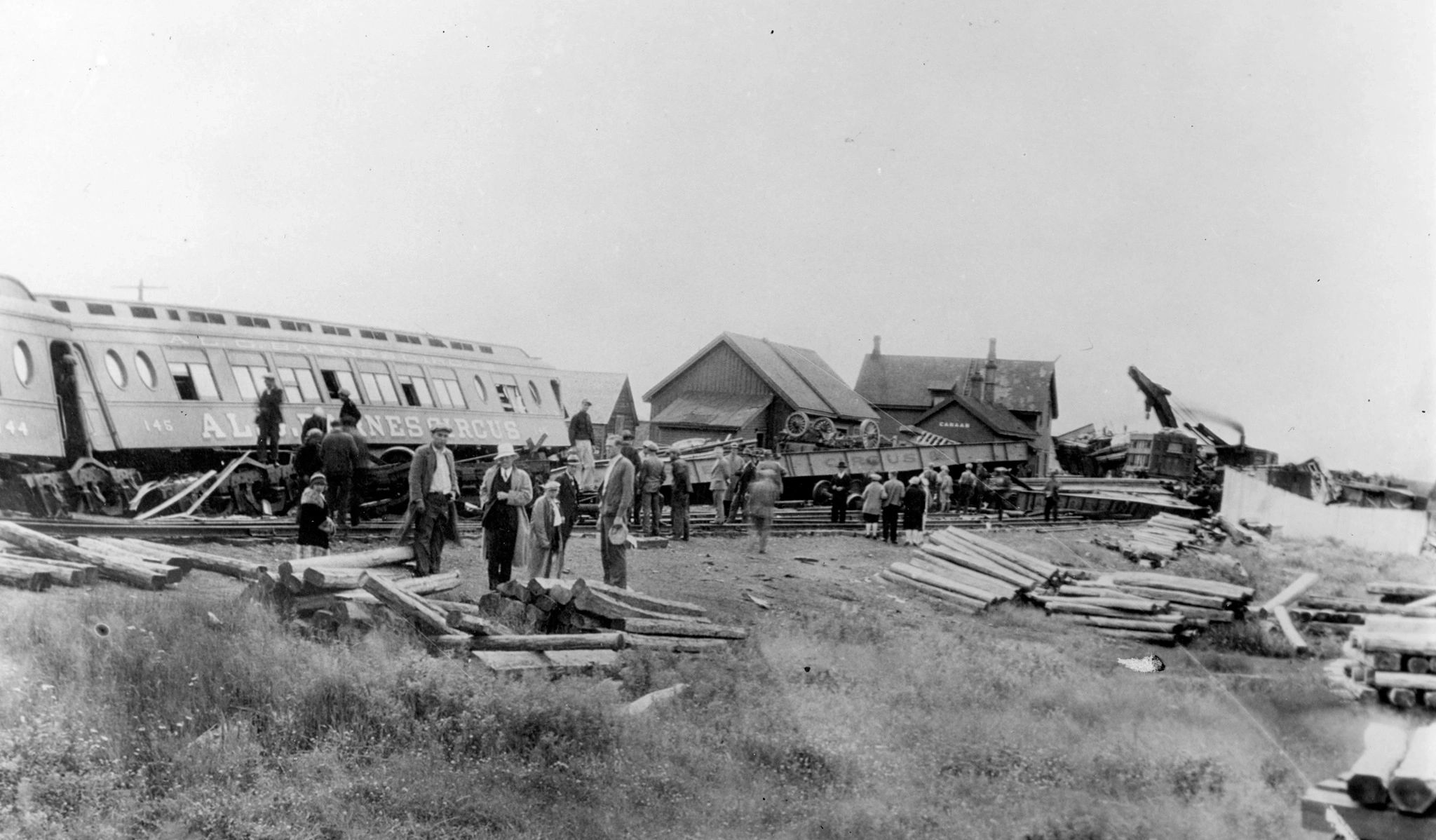
“Circus Train Wreck Most Disastrous Train Wreck In The History Of The C.N.R. Atlantic Region” read the Moncton Daily Times headline. Before the age of television or even radio, and long before the internet, one of the favorite summer events across North America were travelling circuses. One circus met with tragedy outside of Moncton on a hot July night in 1930.
It was a big deal when a circus came to town. Audiences would come to Maritimes towns from rural communities to see dancers, musicians, and circus artists unite, filling the ring with an explosion of color, music, and energy. To smell the aromas of popcorn, cotton candy, and roasted peanuts. To watch majestic elephants, graceful horses, and playful monkeys parade around the ring, showcasing their trained abilities under the guidance of skilled trainers.
By the 1930s, mobile circuses crisscrossed North America on the railways, visiting small towns and large cities alike in summer. During the Great Depression, travelling circuses were a welcome respite from the doom and gloom of the world, and proved immensely popular.
Trains permitted bigger and better circuses that could be dismantled and transported much more quickly. After a run of shows were finished in one town, the circus trains were loaded up at night and the train departed for its next city. However, circus workers were under pressure to move rapidly from town to town to maximise profits.
On the night of July 19th, 1930, Al G. Barnes’ Five Ring Animal Circus had just finished a successful run of shows in Newcastle. Barnes was a railroad magnate who owned most of the circuses on the whole Eastern Seaboard.
The train was loaded late into the evening in Newcastle. However, the loading took longer than expected, with the train only finally departing the station at 4:25am.
It consisted of the locomotive, 10 stock cars carrying the circus animals, then 11 flat cars used to carry the circus wagons, followed by 8 passenger/sleeping cars, and finally the caboose.
It was a very warm summer evening, so many of the circus performers decided to sleep outside. Their sleeping cars were crowded, uncomfortable and humid in the late July heat, making sleeping outside on a lovely night an enjoyable respite. That evening performers rested atop open cars, on flatbed trains, or on top of gondolas.
The train was only 19 miles away from Moncton, at 6:55am, when the crash happened.
The 18th carriage on the train, a flat car, derailed suddenly, causing the cars carrying the performers and workers to derail. Train cars flew off the tracks in a zigzagging pattern.
Performers were thrown from where they slept.
Three were killed instantly, and another died soon after in hospital.
“In the history of the C.N.R. Atlantic Region, never has the toll of life taken been so high” wrote the Moncton Daily Times the next day. Dozens of other people were badly injured.
However, since the stock cars at the front of the train did not derail, the circus animals were not harmed.
Despite the early hour, news spread remarkably quickly in Moncton about the disaster, and it seemed to the dazed survivors that everyone in that city with a car was instantly on the scene, offering to help.
The people of Moncton transported the survivors to hospital, where 17 of them stayed with serious injuries. A multitude of others suffered broken bones. The scale of the circus was so big that every hotel room in Moncton was soon filled with injured circus performers.
The people of Moncton warmly assisted the stricken performers, cooking and delivering food to their hotel rooms.
Seemingly unfazed by the death and destruction, the circus manager announced that very morning to startled Telegraph-Journal reporter C.L. Woods that the Moncton show in two days would continue as scheduled. “The announcement was made within two hours of the catastrophe,” Woods dryly noted “while doctors, nurses and workmen were bullishly engaged in attending the injured and salvaging property.”
Two days later the circus held a funeral procession down Main Street for the performers who died. Dignitaries and the people of Moncton came by the hundreds to pay their respects. It was said to be one of the largest funerals ever held in the city.
Afterwards, the circus held a special performance for the people of Moncton to thank them for their kindness and generosity in the face of their disaster. The circus manager delivered an emotional and tearful speech to the people of Moncton thanking them for all they had done.
The number of the dead were frequently misreported, illustrating perhaps the transient nature of working on a travelling circus at the time. Two of the dead were prop men from Los Angeles, named Albert Johnson and Frank Finnegan, while one was a waiter from Montreal named J. MacFarlane.
The fourth death was casually shrugged off as “an unnamed hobo” by the newspapers at the time.
He was actually John Arthur Stevens, a 23 year old from Saint John. He had earlier lost an arm in a factory accident, and had left home only a week earlier to try to look for work.
An inquest was held into the causes of the crash. At it the driver contradicted newspaper and eyewitness reports that the train had been going too fast, instead claiming the train had actually been going too slow.
The driver blamed a broken track. This was disputed by CN who declared the track had been inspected the previous evening at 5pm.
The circus’ private investigator claimed to have found a snapped archbar on the second car, a mechanical problem that had caused the train’s derailment.
However, CN staff in Newcastle disputed this, claiming they had inspected the train before it departed and that the archbar had been intact.
At the inquest, the circus’ lawyers pinned the blame for the deaths on the employees, arguing it was their fault for sleeping on the flatbeds instead of their berths.
The cause of the crash was declared a mechanical failure rather than negligence due to the train’s driver speeding. The inquest ruled that there was no fault. This meant no compensation needed to be paid to the next of kin of the deceased.
The day after the funerals, the circus train departed for Nova Scotia to perform its next show.