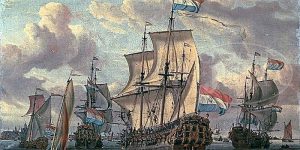
The first Christmas in North America was celebrated in The Maritimes, 425 years ago.
In 1604, Samuel de Champlain arrived on the shores of what is now Canada to found the first settlement in North America. The perpetually cheerful 37-year-old navigator brought four ships from France filled with 120 people, including farmers, craftspeople, ministers, and nobles, tools, and livestock.
They sailed into the Bay of Fundy, noticing St. Croix Island on the border of New Brunswick and Maine. It was close to bird colonies, which apparently were quite tasty (“just like pigeon,” wrote Champlain), and near good fishing areas.
The French encountered local Indigenous people, possibly from the nearby fortified Wolastoqiyik town and trading post of Meductic, who, much to their surprise, greeted them like old friends.
The French quickly built a village that had a fort, wooden walls, one large building called the gallery, a warehouse, a big brick oven, a church, and a mill for grinding corn.
All seemed to be going well until the Canadian winter hit. It was an unusually bad winter, with snow falling in late September. Champlain wrote: “In summer everything is very pleasant owing to the woods, the fair landscape and good fishing … but winter in this country lasts six months!”
The choice of St. Croix Island was disastrous — there was not enough fresh water, and they had cut down all the trees. Worse, the French colonists’ relationship with the Wolastoqiyik fell apart. The cause is unclear, but there were suggestions that the French may have eaten the Wolastoqiyik people’s winter food stash of corn. The result was that the Wolastoqiyik stopped trading with the French for months.
That winter, 35 colonists died of scurvy.
The first Canadian Christmas was a disaster.
Come Spring, the French promptly abandoned St. Croix Island, stripping it of everything they could. The island has remained uninhabited ever since.
The French crossed the Bay of Fundy to Port Royal, Nova Scotia.
The new settlement was joined by a ship carrying much-needed supplies, plus 40 new settlers. Among them was historian Marc Lescarbot, who would write about subsequent events in his bestselling book ‘Historie de la Nouvelle-France,‘ considered by some Mi’kmaq elders today to be the only fair portrayal of them in early colonial history.
Soon after, another, smaller French ship appeared near Port Royal. As it drew closer, the French were shocked to see it was decorated with totems and its sailors were Mi’kmaq warriors.
On board was Membertou.
Membertou was the Sakamaw (Grand Chief or political leader) of all the Mi’kmaq from Gaspe to Cape-Sable. He was also their Autmoin (spiritual leader) and was believed to have powers of healing and of prophecy.
The Mi’kmaq claimed Membertou was 120 years old, but the rational, scientific-minded Lescarbot decided this was an exaggeration and that he was a sprightly, youthful 110-year-old. Membertou, who wore a long beard, was still physically impressive, and so tall he towered over the French.
Seventy-one years earlier, Membertou had greeted Jacques Cartier when he had arrived in Miramichi. While this fact impressed Lescarbot, the arrogant and disrespectful Cartier left a bad impression on Membertou, and he doubted Champlain would be any different.
Charismatic and intelligent, Membertou was instantly respected by the French, but not trusted. The usually optimistic Champlain was especially suspicious of him, and even Lescarbot, who was deeply in awe of the Mi’kmaq leader, admitted they ought to be careful of him.
When winter came, it was again harsh and early. Despite a good growing season and fertile soils, the French did not have enough food stored. The only livestock which seemed to thrive was pigs. "We had pigs," Lescarbot wrote, "which multiplied considerably. Though they had a stable, they preferred to sleep outdoors, even in the winter-time."
Other than that, he wrote, livestock was few; "We had only one sheep, though she thrived well."
With the long winter ahead of them, once again disaster beckoned.
However, beginning mid-November, Membertou and the Mi’kmaq began bringing the French great amounts of food. Membertou carefully balanced charity and business — while the Mi’kmaq generously gave the French enough food to not starve, if the French wanted extra, they’d have to trade for it at a fair price.
Meanwhile, in Port Royal, Samuel de Champlain was many things, but not a doctor. He decided the scurvy which had ripped through his people the previous winter was caused by the French not having enough entertainment. His solution was to found “L’Ordre de Bon Temps,” or “The Order of Good Cheer.” Its motto was “Fellowship and Good Times.”

The first Order of Good Cheer event took place on November 14th, just as the night was falling quickly and the cold was becoming more biting. Marc Lescarbot wrote and organized a comedic play called “Le Theatre de Neptune en la Nouvelle-France,” the first play ever performed in North America.
It was about a group of sailors crossing the Atlantic, encountering the Mi’kmaq, guided by the uncharacteristically friendly Ancient Greek god Neptune.
The play’s theme song went:
“If a man would wish to make his fortune,
He must implore the help of Neptune.
A lubber who won’t quit his own house
Deserves no better name than a louse!”
The play was followed by a feast. Membertou and several Mi’kmaq were invited to the play and feast. Lescarbot did not record what they thought of his play, but they would return to subsequent events and later take charge of some cooking.
The Order of Good Cheer marked the beginning of a “new nobility” in Canada that explicitly flipped the old world order on its head — even if it was in a tongue-in-cheek way — the few nobles in the little colony were in charge of cooking for, and serving, everyone else. At the end of a feast, someone was presented with a crown and was now in charge of providing for and preparing the next event.
Everyone was knighted to be members of the “new nobility” in The Order of Good Cheer, and all were treated as equals. Men, women, children, Catholics, Protestants, Mi’kmaq people, white people, and black people.
One French Black man, Mathieu da Costa, was there and is the first recorded person of African heritage to live in or even visit Canada. He spoke several languages already and quickly picked up the Mi’kmaq language. He acted as the interpreter between the two peoples.
That Christmas, Marc Lescarbot took charge of the preparations, single-handedly decorating the little colony with wreaths and laurel. Christmas Day was mild, and together the Mi’kmaq and French, including Membertou and Champlain, walked two leagues to where the cornfields were, now under a layer of snow. There, they had a picnic with musical accompaniment.
When they returned, Lescarbot and his Order of Good Cheer sous chefs had prepared a grand feast consisting of a mix of Mi’kmaq and French cuisine. The menu included mallard, ruffled grouse, venison of moose, deer and caribou, beavertail (a particular delicacy), otter, bear, rabbit, sturgeon and other fresh fish, and even wildcat!
The French served bread with the grain that remained from France, which was a particular hit among the Mi’kmaq. The bread was baked by a lowly stonemason who had taken up cooking in Canada, becoming the colony’s finest chef, a powerful symbol of the possibilities of change in the new world.
The Mi’kmaq helped the French prepare food, joined in the plays, put on performances, sang, drummed, and were knighted to become part of the Order, equals in every way.
Lescarbot wrote: “We lived as luxuriously as we could have in the street Aux Ours in Paris and at much less cost.”
He complained, however, that they ran out of wine — no small surprise as the French were drinking three quarts of wine per day, every day!
Two years later a year a ship came from France telling the colonists that due to financial problems, they had to come home.
Before he left forever, Champlain gave the keys to Port Royal to Membertou.
This story is included in the book Backyard History: Forgotten Stories From Atlantic Canada's Past
MORE CHRISTMAS BACKYARD HISTORY ARTICLES:
- Santa and The Flaming Christmas Tree Incident
- T'was The Night Before Christmas Maritimes' Connection
- Snapdragons: The Hottest Game of Christmas Past
- Before Santa Claus There Was The Queen of the Fairies
- Christmas 1868 In Their Own Words
- The First Christmas In North America
- A Halifax Christmas Murder Mystery
- Santa's First Appearance In The Maritimes
- Claustrophobia & Santa's Other Misadventures