On October 9th, 1839 a church burned on Grand Manan, and an effigy of its priest was left hanging nearby. The man who ruled the island like a medieval lord, who was nicknamed “The Emperor of Grand Manan” was blamed, though he argued there was a conspiracy against him…
In the early 1800s, New Brunswick’s government was very different from how it is today.
Power was delegated to extraordinarily powerful local leaders who were in charge of everything from hiring people, building roads, interpreting laws, and even being in charge of the local militia. There was very little for these local leaders.
In an isolated place like Grand Manan Island, this was ripe for abuse of that power.
Wilfred Fisher was from St. Andrews, on the mainland. He had moved to Grand Manan at 18 to take a land grant.
He learned how to read and write. This gave him a distinct advantage in an island where few could.
He may have been the only person on the island who could read and write … virtually all of the letters to the government from the island from the time were written by him – regardless of who actually sent them.
He received a land grant at Priest Cove, and then High Duck Island, near Woodward Cove. He established himself as a merchant selling a bit of everything, but likely mostly outfitting fishermen.
Merchants on Grand Manan were infamous for exploiting fishermen by financially exploiting them. They would offer them credit, get them in debt, and then demand to buy their fish on the cheap, locking the fishermen into a cycle of debt.
Historian Wade Rippitt wrote: “Before 1832 Wilfred Fisher had no social, civil or religious peer with whom to share the public notice and servility. In each of his capacities, whether Commissioner of Highways, Overseer of the Poor, Magistrate, or Captain of the Militia, he was imperfectly restrained from acting in callous disregard for the people’s interests, and had acquired over time the reputation of a tyrant.”
As resentment built, a nemesis appeared: a young missionary from the Church of England, a Deacon.
The people of Grand Manan were deeply impressed by him. The island had been without a Minister for two years. The Island’s last minister, William Ross, had died under mysterious circumstances after falling out of an open boat two years earlier.
The new young Deacon, named John Dunn, decided to move to Grand Mana and was joined by his wife Anne and their infant child.
According to historian Wade Rippert, Dunn “acted with strict, self-sacrificing magnanimity … although somewhat priggish about the dignity of his calling and his place in the community.”
It is difficult to pinpoint the beginning of the dispute between the Reverend and Fisher. Indeed, early records show that they were quite the opposite of enemies at first: in fact, Fisher had generously donated large sums of money to Dunn.
Rippert suggested that Dunn’s arrival caused friction with Fisher: “He seems to hae viewed Mr. Dunn’s arrival as the intrusion of a young upstart who, as the result of a few year’s study of divinity, was elevated in the public esteem above himself, the more mature and experienced man. Mr. Dunn, for his part, did not sufficiently weigh the consequences of aggrieved dignity in a man proud and powerful.”
Dunn had been promised a salary of £150 a year, but much to his surprise learned that the islanders were expected to pay half of that themselves.
For most islanders locked in an exploitative cycle of debt with the merchants, a regular consistent wage was entirely foreign.
Each Sunday Dunn began by preaching a morning service in his Church. Then rode his horse up to North Head for a 10 o’clock service in the schoolhouse, then off to Seal Cove for another service, then back to his Church for a fourth service.
Meanwhile, his wife, Anne, would travel separately to the Sunday Schools happening at different points of the island at different times, and she would administer those.
At a New Year’s Day meeting in 1833, less than £25 was raised for Dunn’s salary – and nearly half of the money that was raised came from Fisher himself. Lacking money, and personally paying many of the church’s expenses himself, the Reverend began going into debt. He began owing increasing sums of money for basic necessities like his family’s food, clothing and firewood to different islanders.
In an effort to cut down on his expenses, Dunn decided to stop renting the stable for his horse -which was a three-mile walk from his house- and keep the horse in a pasture on church land.
The issue with that was that church land (called a Glebe) was common land, maintained by Grand Mananers, and when Dunn built a fence to keep his horse enclosed, angry Islanders almost immediately tore it down.
The finer points of property law were likely on Dunn’s side in this dispute.
However, Grand Mananers would have felt that their title to the land was the fact that they’d removed it from nature through the toil of their hands, and that claim to it was more legitimate than any piece of paper signed by an official.
In the wake of this land dispute, it appears that Fisher stopped making his very considerable donations to the church, which covered nearly half of the money it received.
In a deposition the following January, John Dunn himself described the fire:
“I was awakened by the screams of Mrs. Craig living near my house; on opening the front door and looking out, I saw the Church … full of flames breaking out … directly after my first seeing it it broke through the windows and shortly after it through the roof then spread over the building til the roof fell in.”
Swinging in the night air, illuminated by the flames of the burning church, the Reverend saw hanging from a tree an effigy dressed in a long black waistcoat, satin vest, a pair of black pantaloons, white gloves and black boots, hanging by its neck. He was staring at an effigy of himself.
Historian Wade Reppert imagined what that night would have felt like for John Dunn: “the distress that Mr. Dunn must have felt for his family, his agony of spirit, beseeching God to show a merciful design for the catastrophe. Think for a moment of his wife, Anne, trying to solace the frightened child, herself in need of a comforting word, having cast away the hope that life should ever again be bearable in this place where someone so fervently despised her husband.”
News of the church fire swept Grand Manan and reached Fisher’s store by breakfast time. Fisher, as Grand Manan’s high magistrate, set off at once to the church. Reaching the church, he stared at the effigy, and eyewitnesses said he averted his eyes and said “I don’t know anybody who wears such clothes on this Island but me.”
Church Meigs, a vestryman from Castalia, recounted that Fisher pointed to the knot and said “That’s a hangman’s knot.” When Meigs pointed out that only six people on the island could tie such a knot, Fisher tied a hangman knot to demonstrate.
That Sunday Reverend Dunn gave a defiant Sermon, which was later published in newspapers across New Brunswick, in which he revealed that on the effigy was found a piece of paper, which threats against himself, the church and four other people on Grand Manan.
During the Sermon, Dunn said: “And although the profane and sacrilegious hand may have aimed its blow at the destruction of the Church, and the removal of its minister, it is the earnest wish of us all, and we are confident the almost universally prevailing feeling that the designs of those ‘workers of inequity’ may prove completely unsuccessful … unite with us in devout prayers that the ‘Disposer of all Events’ who has permitted us to be so previously visited, will be favourable unto us, and prosper us, we may have the strength to rebuild ‘the waste places of our Zion’ that we may worship there ‘in spirit and in truth’ and have beauty for ashes, the oil joy for mourning and the garment of praise for the spirit of holiness”
The New Brunswick government took the matter very seriously, offering a £100 reward for information, and dispatching its highest-ranking legal expert, William Boyd Kinnear, to Grand Manan to investigate.
Kinnear’s investigation found a lot of hearsay and many islanders pointing the finger at one another. It did, however, reveal that the fire had been started by an unusual pipe, engraved and painted to look like a human skull. Its owner was Elisha Young.
Being that Young was an employee of Fisher, Kinnear turned his eye towards the powerful magistrate. Kinnear decided that by acting so obviously guilty at the scene of the church burning by pointing out the clothes and the knot, Fisher was trying to mislead them into thinking nobody guilty would ever act so suspiciously.
Furthermore, the investigator decided that Fisher’s repeatedly pointing out the earlier incident over the church land dispute, and accusing those involved with it, was suspicious.
The trial took place in May of 1840. On May 23rd, the New Brunswick Courier published a report on the three-day trial, which they reported it had “created general interest, from the enormity of the offence charged, and the high standing of Mr. Fisher in the community as an honest and respectable man.”
The report continued that the jury “declared, without leaving the box, they were satisfied and at once pronounced an acquittal of the parties accused.”
The Saint John Observer newspaper wrote that “Judge Carter addressed the prisoners and expressed in the strongest terms “his entire belief in their innocency,” adding, “that Mr. Fisher was extremely fortunate in having an opportunity to refute the charges, and that his character stood unimpeached.” ”
The speed of the acquittal -in which the jury made their decision without even leaving the room- was taken as proof by the Saint John newspapers that Fisher must be very innocent indeed.
The New Brunswick Courier, which typically prided itself on staying neutral, published a highly uncharacteristic editorial in which they wrote that “his triumphant acquittal will doubtless afford them, as it does us, the highest satisfaction.”
Back in Grand Manan, however, the fact that the jury acquitted Fisher without even leaving the room to deliberate was not seen as evidence that he was innocent, but that something underhanded was happening. After all, Fisher wasn’t being tried on the island, but rather on the mainland, in his own hometown of St. Andrews.
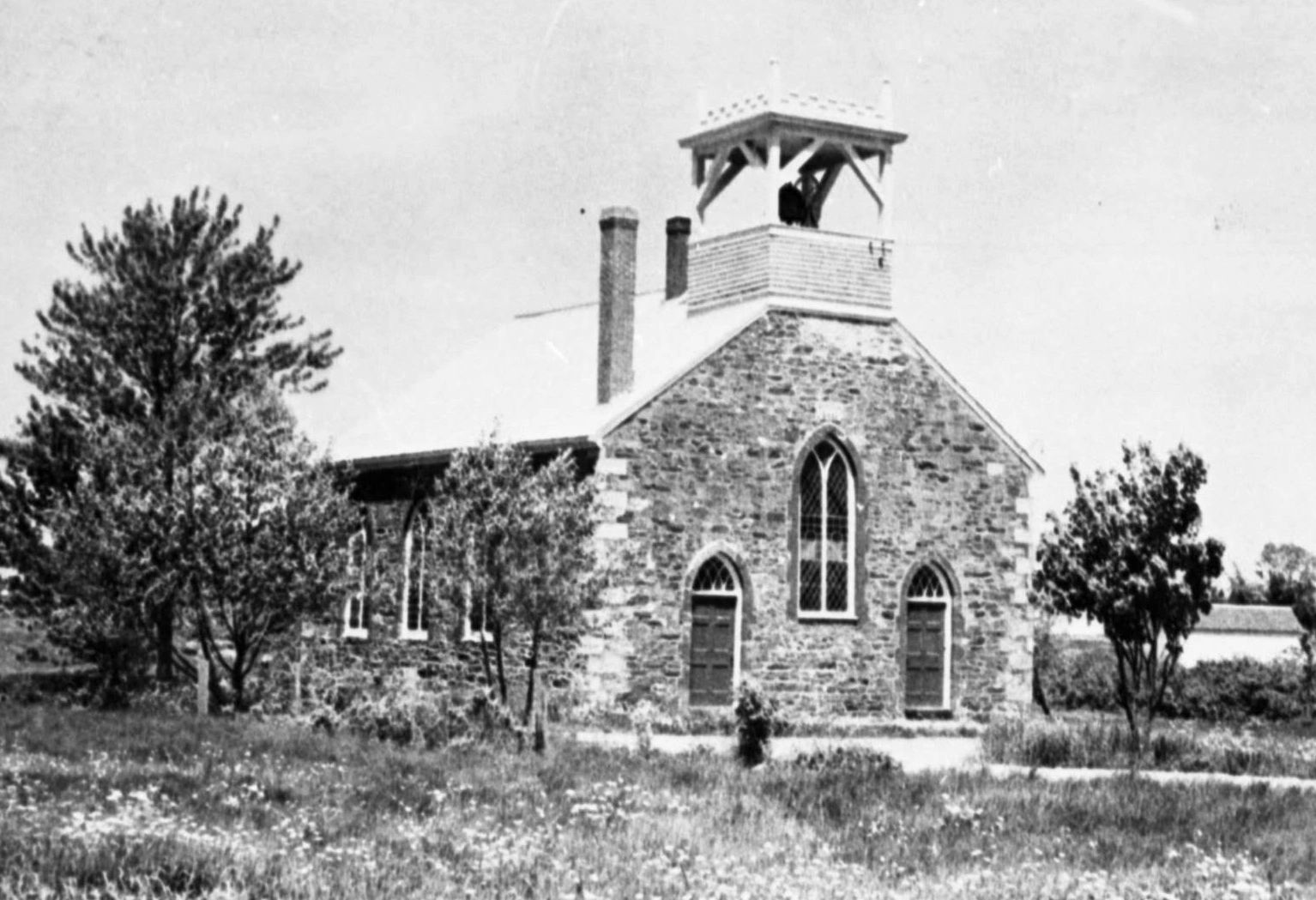
Meanwhile, Reverend John Dunn defiantly announced that they would build a new stone church on the very ruins where the former wooden church had been. This was no simple feat – nor a cheap one. Despite donations flowing in from across Grand Manan, and from the Mainland, there would not be enough money.
Anne Dunn, who had never left New Brunswick before in her entire life, set off on a gruelling fundraising voyage to England.
She returned 13 months later with a collection of maps and books, and £652, which covered the vast majority of the £719 it cost to build the new stone church, which still stands on Grand Manan today. Between the two of them, they raised more than enough money for the church and used the remaining money to build a school.
The stone used to build the church was locally quarried but was so heavy that roads had to be built to haul it.

22,000 shingles were needed for the roof, and they were all split and shaved to a taper by hand.
450 pounds of nails and spikes were used in the construction.
15 bushels of horse hair were mixed with lime and plaster and lathed onto the ceiling and walls.
400 panes of glass were donated by Saint John merchants to form the grand glass windows.
Reverend John Dunn died five years after the church was completed, of consumption, at age of only 40.
Though Wilfred Fisher was declared innocent by the courts, he was not considered innocent by the people of Grand Manan.
The next spring, when he ordered his beloved militia to mobilize for exercises, they refused.
As he was still in charge of law and order on the island, yet held no moral authority among the population, a dark decade of open flouting of the law, leading to theft, arson, drunkenness and violence would rock the island until he finally moved to Maine.