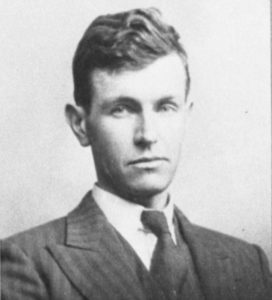
We have all heard stories of soldiers lying about their ages to enlist in the World Wars. New

Brunswick has the curious distinction of being the home of one of the youngest soldiers to have fought in the First World War – a 13-year-old who dropped out of school to fight in one of the bloodiest conflicts in human history.
Levi Prosser was born on October 18th, 1900, meaning that when he walked into the recruiting office in his hometown of Sussex on October 16th, 1914, he was still only 13 years old.
He told the recruiters that day was his 18th birthday.
The Kings County Record later wrote: “He was a fairly big boy, and when he told Dr. Pearson, the medical examiner, that he was 18, the doctor had no particular reason to doubt.”
His enlistment papers have him measuring five feet five inches.
Prosser was certainly not alone in lying about his age to go to war. Remarkably, he was not even the youngest Canadian soldier in that war. Robert Thompson from Picton, Ontario, beat him for that dubious distinction by several months.
Before going off to war, Levi Prosser was attending the Sussex Public School, where he attended Miss Parker’s grade five class. When asked at the recruiting station what he did, he said he was a chauffeur.
Prosser was sent to Amherst for two months of training before being sent overseas. The British, appalled by the poor training the Canadians received, had them train for several months more before allowing them to the front.
Prosser landed in France on September 15th, 1915, arriving in the muddy and bloody trenches on the front shortly before his 15th birthday. He would spend the next 12 months on the front lines.
Figuring out the exact nature of what Levi Prosser did in the war is slightly difficult, largely because there seems to be a discrepancy between his service records and what he later told newspapers he had done.
After the war, Prosser told the Kings County Record, that he was shot in the shoulder during the Battle of Vimy Ridge. While he was indeed hospitalized while participating in that battle, his service record claims that he was hospitalized for his acne.
Acne could be quite severe, though. Living in the mud and dirt, covered in sweat and without a change of clothes for weeks, could lead to massive, oozing pustules. These could inflame and interfere with the sinuses. Often very painful, trench acne sometimes needed to be lanced and
drained by medical professionals. In the absence of antibiotics, this came with a risk of infection that could lead to disability or even death.
Prosser also told the Kings County Record that on September 6th, 1917, he was fighting in Passchendaele and was gassed. According to his service records, however, that day he was arrested for stealing a cigar, and was reduced in rank from a Lance Corporal to a Private for it.
After his first 12 months on the front, Prosser was no longer directly involved in fighting anymore.
The Canadians were creating a new motorized division and were looking for drivers. Though it’s not clear whether or not Prosser had ever actually driven a car before the war –it’s possible; his father was a veterinarian technician, and perhaps he helped– he had listed himself on his enlistment forms as being a chauffeur.
Since he claimed to be an experienced driver, the 15-year-old was chosen to drive troops and trucks around a warzone.
He spent some months with the Army near the front, driving within range of artillery shells, while some months were spent driving in the safety of England.
The youngest soldier to fight in the First World War was 12-year-old Sidney Lewis, from Britain. After an argument with his mother, he ran away from home and enlisted in the army. When his mother eventually learned that her missing son was fighting at The Somme –one of the bloodiest battles in human history– she angrily wrote the War Office demanding he be sent home, which he was.
Levi Prosser’s underage military career ended in much the same way.
After the war, Prosser told the Kings County Record he was discharged after being wounded in battle and sent home on October 10th, 1918.
His service records tell a different story.
On March 3rd, 1918, a tersely worded note appeared on his service file reading simply: “Dispatched to base as minor. 17. To be held pending investigation.”
Months earlier, on Levi Prosser’s 16th birthday, a woman walked into the Hastings recruiting office in Sussex, quietly dropped off a letter, and left.
She was Jane Prosser, Levi’s mother.
The letter revealed her son’s real age.
Unlike 12-year-old Sidney Lewis, who had not told his mother he was joining the Army, Levi Prosser’s mother likely knew where he was. He had been sending her $20 of his pay each month. This was a remarkable portion of his income when Canadian soldiers were only paid $1 per day.
He was hardly the only minor in that war. Some estimates suggest a quarter of a million minors from Britain alone enlisted. Nonetheless, the Army seemed baffled at what to do with him after his mother’s revelation, presumably as he’d already been in uniform for three years by then.
He remained on base for a month and then was sentenced to a month in jail for lying about his age.
Intriguingly, after only a matter of days in prison, he was released and sent on an extended leave that sounded suspiciously like a vacation in England.
Finally, that September, he was discharged and sent back home to Canada.
On October 18th, 1918 –his real 18th birthday– Levi Prosser went to the Fredericton recruiting office and signed up for the army a second time.
Three weeks later, the war ended.
As part of the discharge process, soldiers’ heights were measured. Levi Prosser now stood 5 feet 10 and a half inches – he had grown five and a half inches during the war that he had signed up for as a 13-year-old.