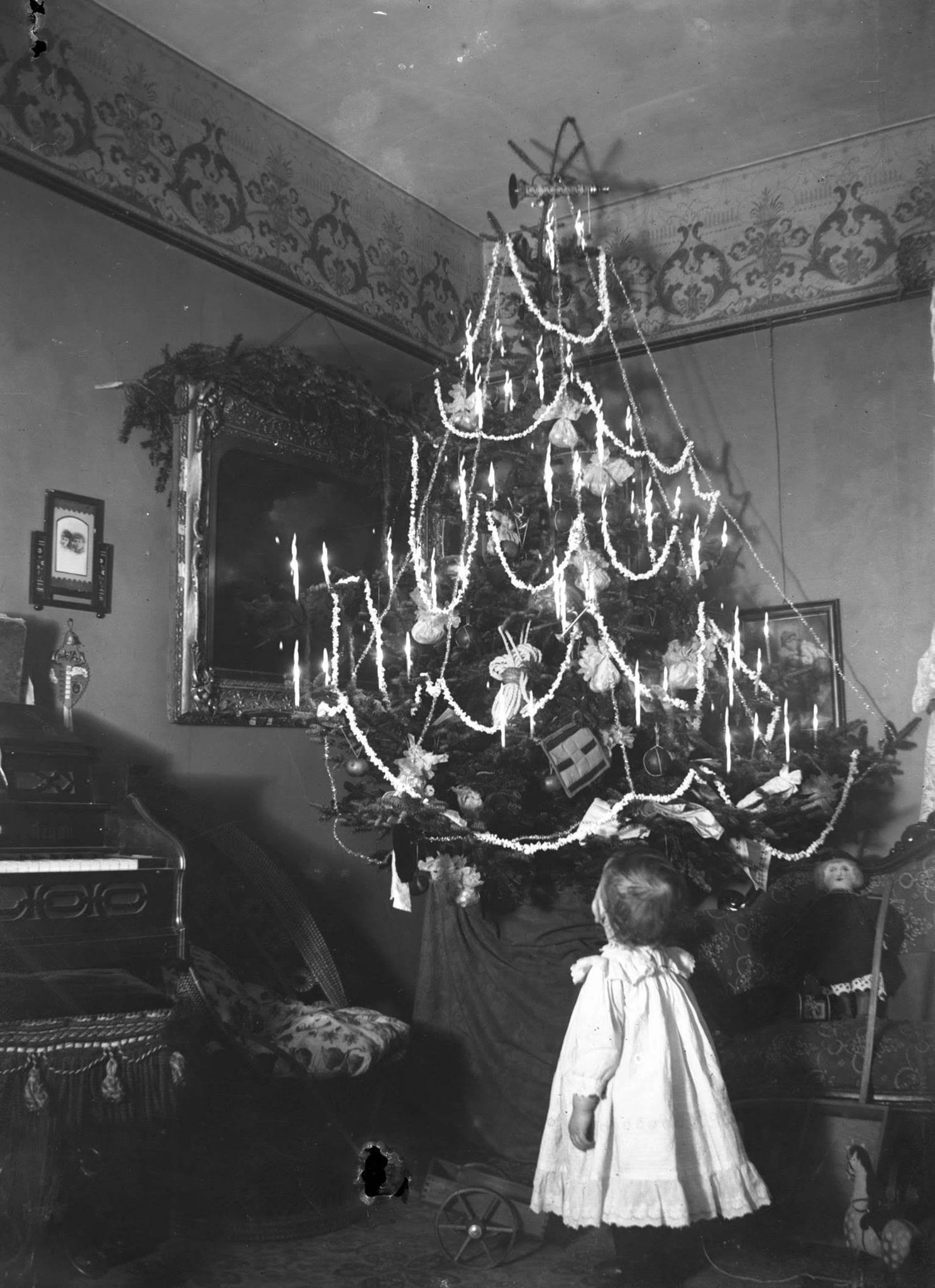
Early Maritimers embraced most Christmas traditions we still enjoy today, except for the Christmas tree. This was perhaps in part due to Santa Claus narrowly escaping a very public and rather bizarre 1887 flaming Christmas tree incident in Saint John… MORE CHRISTMAS BACKYARD HISTORY ARTICLES:
- Santa and The Flaming Christmas Tree Incident
- T'was The Night Before Christmas Maritimes' Connection
- Snapdragons: The Hottest Game of Christmas Past
- Before Santa Claus There Was The Queen of the Fairies
- Christmas 1868 In Their Own Words
- The First Christmas In North America
- A Halifax Christmas Murder Mystery
- Santa's First Appearance In The Maritimes
- Claustrophobia & Santa's Other Misadventures
Experience this hot tale of Christmas past on the Backyard History Podcast!
Many Christmas traditions date back to Victorian Britain. They were introduced first to Fredericton by British troops stationed in the city. The homesick soldiers brought over their old traditions, and Frederictonians wholeheartedly and enthusiastically embraced them. From there the Christmas traditions would slowly spread to the rest of The Maritimes.
Fredericton, later followed by the rest of New Brunswick, fell in love with the decorating, the Christmas cards, the pageants, the feasts, and Charles Dickens’ humanitarian ideals, in which Christmas was a time to care for children and the least fortunate in our societies.
Fredericton, though a small town, and not a particularly wealthy one either, came together to put on special feasts, and plays for Christmas These fundraisers were for the poor, orphans, unwed mothers and the disabled of their city. In New Brunswick, Christmases in the 1800s were about generously helping the needy.
We would instantly recognize those early Christmases. There was caroling, big family dinners, boughs and wreaths, pageants, and giving gifts. Notably, even back then Christmas was commercialized just like today, with old newspapers being filled with Christmas ads from the beginning of November on.
There was only one thing that was missing: Frederictonians would not put up Christmas trees in their houses.
This isn’t to say that Frederictonians had an irrational hatred for Christmas trees. There were Christmas trees in every church and school in New Brunswick’s capital city. But Frederictonians back then could not wrap their heads around the idea of bringing a tree in the house. The reason was simple: trees belonged outdoors.
In early Frederictonians’ defence, Christmas trees traditionally weren’t decorated until Christmas Eve, meaning that for much of December they did indeed simply just have a plain old tree sitting inside of their house. Perhaps this was charming in Britain's large urban centres, but was perhaps less so in Eastern Canada where trees were all around.
There was, however, another very practical reason for Fredericton’s suspicion of Christmas trees: they could be quite dangerous!
At the time Christmas trees were lit with burning candles.
Obviously, having several little open flames all over a dead tree inside a house was a fire risk. Christmas trees were therefore usually only ever lit for at most 10 minutes, typically on Christmas Eve, right before children went to bed.
During the tree lighting adults waited nearby with buckets of water and sand in case of a fire, which understandably might take away from the joyful mood.
In fact, Santa Claus nearly met his end in Saint John at the hands of a burning Christmas tree.
Santa was in West Saint John’s Fairville Methodist Church on December 28th 1887, distributing presents to a room full of children near a Christmas tree lit with candles.
Suddenly, according to The Saint John Globe newspaper, one burning ornamental candle “caused quite a fire near the top of the tree and out of reach.”
Santa’s quick thinking assistant grabbed a long stick and hit the burning ornament off of the tree. This put out the tree fire, averting a potential catastrophe, but unfortunately the still-burning ornament landed right at Santa’s feet.
According to The Globe: “Santa Claus immediately proceeded to extinguish the flames by stamping on them, but in an instant the flames had caught the corner of his long coat, encircling it from the bottom from edge to edge and rapidly advanced upwards.”
“He leaped from the platform and started to run down the aisle for the door, but had scarcely left the platform before his form was completely wrapped in flames, presenting a sight not soon to be forgotten by those who witnessed it,” continued the newspaper.
Completely engulfed in flames, Santa Claus charged down the church’s aisle as terrified children ran away screaming. He burst through the front doors, careening out onto the street, running down the road tearing off parts of his flaming heavy red suit –which luckily had been only loosely buttoned– throwing them into the snow as he went.
Miraculously, with the exception of some light burns on his hands, Santa emerged unscathed.
Inside the church, an announcement was made that Santa was okay.
The announcement, the Saint John Globe noted, “failed to allay the excitement of the children.”
It would be decades after The Flaming Santa Incident before Christmas trees were common inside of houses. By then the trees were lit not by burning candles but by much safer electric lights.
MORE CHRISTMAS BACKYARD HISTORY ARTICLES:
- Santa and The Flaming Christmas Tree Incident
- T'was The Night Before Christmas Maritimes' Connection
- Snapdragons: The Hottest Game of Christmas Past
- Before Santa Claus There Was The Queen of the Fairies
- Christmas 1868 In Their Own Words
- The First Christmas In North America
- A Halifax Christmas Murder Mystery
- Santa's First Appearance In The Maritimes
- Claustrophobia & Santa's Other Misadventures


