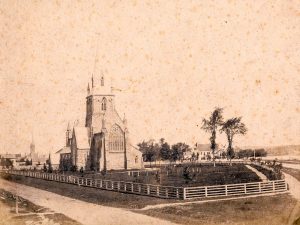
One Summer Fredericton was rocked by a riot at a circus, which kicked off after a dead snake was thrown at a performer. By the end of the circus riot of 4 people had been shot, 18 arrested, hundreds caught up in violence, the circus workers had taken over the city’s Armory, the circus had been thrown into the St. John River, and the circus’ owner had fled the country.
This story is included in the book Backyard History: Forgotten Stories From Atlantic Canada's Past
In the Maritimes in the 1800s summertime was circus time. It was a big deal when a circus came to town. Often they would have a big parade through towns to announce their coming, featuring animals, costumes, music –live or even recorded— and garish and colourful signs. If you were lured by the parade back to their circus you could experience pink lemonade, cotton candy and the bright lights and sounds, and performers from around the world.
This didn’t necessarily mean that all circuses were family friendly. Circuses could be dark places at the time. The workers they attracted were often misfits leading precarious lives, who had a reputation for “grifting” or ripping off those who attended.
On the flip side, the circus could also attract unsavoury audience members who were often quite rough, seeking to drink excessively and blow off steam. These audiences saw circuses as a place they were free to be crude, rude and lewd.
On Sunday July 6th 1874 “The Great And Only New York Circus,” owned by Louis B. Lent rolled into the Fredericton Branch Railway station.
Lent’s circus was mostly equestrian, featuring horse performances. It advertised shows such as bareback horse riding, a woman who could ride six horses at once, an Australian rider, and a family of gymnasts.
The circus offloaded from the train onto wagons and moved to set up down by the river at the end of Carlton Street – where the Fredericton Public Library now stands.
They received a chilly reception from the outset. Sunday was the Sabbath and officials in Fredericton refused to let Lewis’ circus set up that day.
While the circus performed as normal on the Monday and Tuesday, it was not without incidents.
A Frederictonian and a circus worker selling tickets at the gate got into a dispute over whether they got back correct change, which escalated to the circus worker punching the patron in the face.
During one performance a group of boys climbed up the tent’s ropes for a better view. When they came down they got into an argument with the circus workers which attracted an angry crowd and ended in violence.
Later a local young woman was found by a group of young Fredericton men behind a tent romantically entangled with a circus worker. The young men took offence to this and decided to return her to her home. Though there were never any accusations that the tryst was anything but consensual –and the young woman aggressively protested being taken home— the incident led to a shouting match, further escalating tensions.
On its final day in Fredericton, Lent’s circus put on three performances; a matinee show, an evening show and a final concert.
As the circus was shutting down and the spectators were filing out after the concert, the circus workers began to set about taking down their tents.
A group of local young men stayed behind to harass them, heckling the circus people as they went about their work.
At first the circus workers ignored the catcalls and insults of the Frederictonians.
Then a Frederictonian threw a dead snake –of all things— at a circus worker.
The snake hit its target and wrapped around his neck.
The stricken circus worker shouted “Hey Rube!”
“Hey Rube!” is sometimes still used today in theatrical performances to alert performers about a potentially violent audience member. Back in the 1800s however, “Hey Rube!” was the battle call of the circus worker; a call to arms that a dangerous and even potentially lethal fight was on. Indeed the 1884 edition of the Oxford English Dictionary included the phrase with the definition: "A canvasman [circus worker] watching a tent is just like a man watching his home. He'll fight in a minute if the outsider cuts the canvas, and if a crowd comes to quarrel he will yell, ‘Hey Rube!’ That's the circus rallying cry, and look out for war when you hear it."
When the stricken performer with the snake wrapped around his neck shouted “Hey Rube!” a chorus of responding shouts of “Hey Rube!” rang out across the circus, and performers rushed over ready to fight.
The Frederictonions loitering by the tents were quickly overwhelmed and driven away from the circus.
Then someone rang a fire bell.
In the age when most homes were wooden and there was little fire insurance, hundreds of Frederictonians rushed to the source of the fire bell to help put out the fire.
However, instead of a fire they encountered a big brawl between the circus performers and some local young men.
So they joined in.
The circus people responded to the crowd now numbering in the hundreds by pulling guns out and firing buckshot at the crowd in an effort to drive them back.
The buckshot, however, seemed to only further enrage the Frederictonions.
As the riot grew worse, some of the circus people pulled out revolvers and shot at the crowd with actual bullets.
The circus people fired 25 shots at the crowd, injuring 4. The Daily Telegraph wrote “the wounded citizens are Samuel Macauley, shot in the leg; David Carr, bullet in the hip, not yet extracted; McLean, pistol wound in the head, and Lowry, shot in the thigh.” All of those who were shot recovered.
Remarkably, the rain of bullets did little to stop the enraged Frederictonians.
The Daily Telegraph newspaper described what happened next: “The riot assumed formidable proportions. The report of the fire arms mingled with the cries of the combatants, and the groans of the wounded alarmed the whole city.”
Fredericton was still reeling from an earlier shocking and brutal religious riot between Catholics and Protestants, and was in the midst of forming its first police force explicitly to quell riots in the city. However, the police force was still being formed and at the time only had two officers.
Mayor Edward Wetmore was just down the street at City Hall as the riot was breaking out, and quickly assembled a judge and two dozen men, with the judge ‘deputizing’ a makeshift police force.
The two dozen new ‘police’ descended on the square, launching themselves into the fray and attacking both sides.
The circus people, for their part, saw little difference between the new Frederictonians claiming to be police and the Frederictonians who had attacked them. They retreated and somehow managed to get into the armories –located in the same place as the current armories, across the street from the library– barricading themselves inside. They spent the night and most of the next day there.
Meanwhile, outside of the Armories, Frederictonians dumped all their tents, carts, gear and supplies in the river. It is unclear what happened to the circus’ horses.
The circus’ owner, Louis B. Lent, who would have stood out at the time since he weighed 300 pounds, managed to slip away during the commotion and fled the country to the United States.
After eventually coming out of the Armory the next day, 18 circus workers, abandoned by their boss and with their belongings on the bottom of the river, were arrested and imprisoned in City Hall’s basement. All of them were soon let go without charges. Despite there being hundreds of people involved, the court concluded there was insufficient evidence.
Newspapers took pains to blame both sides for the riot, but in the aftermath it seemed that many came to blame drunken locals. New Brunswick’s drinking culture at the time would startle many of us today, and soon after this event several groups like the Women’s Christian Temperance Union began campaigning across the province to ban alcohol when circuses were in town.
Louis B. Lent’s ill fated trip to Fredericton marked the end of the circus he had run for the past 8 years. Lent returned home to New York City, where he formed “The New York Circus, Museum, Menagerie, Caravan & Zoological Garden” at Madison Square Garden. It seems that Lent’s zoo formed one of the precursors to what is now The Bronx Zoo.
Remarkably, this was not even the only circus riot in New Brunswick that summer – one month later a circus in Bathurst descended into a brutal riot which left several circus people so severely injured they had to be transported to Nova Scotia for treatment.
This story is included in the book Backyard History: Forgotten Stories From Atlantic Canada's Past